Food Labels Can Be Misleading: Here’s How to Spot What Really Matters
Two things clients often ask me are, “What should I eat?” and “Is this food product a good choice?”
Those are excellent questions. How do you know if food is a really good choice?
The secret is knowing and understanding how to look at the nutrition facts and ingredients list. But it goes beyond that.
It’s also about knowing what to ignoreon food packages and labels.
So, how can you avoid being fooled by some common tricks marketers use on food packages and social media?
In this blog post, I’m sharing some simple things you can do to avoid being fooled and feel more confident about making good food choices.
How to avoid being fooled by food packages and labels
When you’re in a grocery store or shopping online, it can be so difficult to decide what are good choices for you to eat. The front of every package, or the description if you shop online, is designed to get you to do three things:
Notice the item
Think that it is the right food for you
Buy the item
That last point is especially important!
Now, the company that’s producing the product and the marketing team they’ve hired to design the package and promote it online and on social media really do not care if the product is good for you or not. They are only interested in getting you to buy it.
That may sound harsh, but it’s true.
Protein is the new ploy to get you to buy
This is especially true with breakfast cereals and hot cereals these days. The front of the box may scream “More protein” or “With X grams of protein,” but it may not mean that the item is a good choice for you.
Yes, I’ve talked before in this blog about how protein can work for you or against you. I also talk about protein in nutrition counseling sessions, especially with people seeing me for help while taking weight loss drugs like Ozempic, Wegovy, Zepbound, Mounjaro, or other GLP-1 GIP incretin medications.
Protein is important, but that does not mean that a cereal labeled as “higher protein” is a good choice for you.
I’ve said it before, and I’ll say it again:
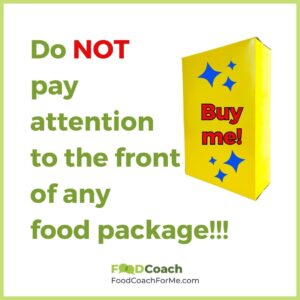
Do NOT pay attention to the front of any food package!
The front of the package is prime marketing space.
It tells you what the company wants you to focus on, not necessarily what you need to focus on. Those are two entirely different things!!
3 Steps to figuring out if the food you’re buying is a good choice
Flip the package around. Keep on flipping it around until you’ve got to the ingredients list and the nutrition facts label.
Do not pay attention to anything (and I mean anything!) other than those two items on the package.
It can also help to compare that product to the company’s “simpler” product, like the “plain” version of the cereal from the same company. Look at every item and compare them.
You may find that the “protein” version of the cereal, while it has more protein, may have more of some items you want to limit or avoid.
How to figure out what to look at on the nutrition facts label and food packages
There are quite a few you should consider when looking at the ingredients list and nutrition facts label. There are some you should ignore. That’s more than I can get into in this post.
Many people look at the wrong things on the nutrition facts label or interpret the information incorrectly. Teaching you what to look for (and what to ignore) on food packages and nutrition facts labels is one of the things I focus on during nutrition counseling sessions with clients.
If you’re not confident you know what to look for to make good food choices, here’s what to do:
We’ll talk about what you want your food purchases to do, what you are trying to accomplish, and what the first steps are to learn how to make food choices that benefit you and your health.
P.S. If you decide to work with me, many insurance plans cover all or most of the costs of working with me.
Having personally struggled with weight and gut health issues, I understand how easy it is to think that food is the enemy especially with the changes our bodies undergo as we age. It doesn’t have to be that way!
I love using my extensive education and coach approach to help people realize it is possible to feel better and be healthier while still enjoying their life and food.