High food prices don’t have to get in the way of eating better!
The high cost of food can make it seem harder or more expensive to eat healthier, but there are ways to lower your grocery bill and eat healthier without spending more time in the kitchen. Here are five easy ways to save on groceries the next time you shop!
Tip 1: Make pasta sauce, pizza sauce, and soups go further
Typically, the more processed a food is, or the more ingredients it contains, the higher the price. Looking at the unit pricing information on the shelf tags (or the shopping app for your store) makes this very apparent.
Using unit pricing information makes it easy to make a more expensive product go further by pairing it with a less expensive healthy product. This lowers the cost per serving and boosts the “healthiness” of what you are serving.
For example, when I wrote this the store brand of spaghetti sauce cost $1.20 per pound. The store brand of diced tomatoes costs $0.96 per pound. So do this:
Make the more expensive spaghetti sauce go further by simply adding a can of diced tomatoes to your sauce before heating it up!
If you’re using canned soups, a similar thing can be done.
For instance, a can of chicken noodle soup costs between $2.90 and $3.28 per pound when I wrote this. Adding some frozen green beans ($1.50 per pound when I wrote this) to the soup before heating brings the cost per serving down and adds more non-starch vegetables to your day. Other vegetables, or even leftover roasted vegetables, could even be used.
Tip 2: What’s in your cereal bowl?
If you or someone in your household eats cereal for breakfast, you may have noticed “shrinkflation” as some call it. That is the number of servings per box has gotten smaller with the price staying the same…if it hasn’t gone up. So what to do about it?
Here’s where thinking about cost per serving can help. Because the weights of different types of cereal differ,
unit pricing, which is usually based on weight or volume, won’t always help.
To calculate the cost per serving, take the item’s price and divide it by the number of servings from the nutrition facts panel. Changing your choice of cereal may help reduce your grocery bill.
To reduce your grocery bill even more, and boost your health, consider using oatmeal instead of cold cereal several times a week.
Here’s the info on how it can help your grocery bill:
When I wrote this an 12 ounce box of Cheerios™ cost $5.49 at a major grocery store in my area. Looking at the nutrition facts panel shows this box provides 8 servings per container. That’s 69₵ per serving. A 42 ounce container of oatmeal costs $3.89 and has 30 servings per container. That’s 12₵ per serving. A big difference!
Even if you chose the instant variety pack from Quaker (8 individual serving packets for $3.99 is 50₵ per serving), you’d save money compared to cold cereal.
Tip 3: Use frozen vegetables, but be careful what you choose
Although I’m an avid vegetable gardener and love locally raised vegetables, I also often recommend frozen vegetables as a good option and frequently use them myself. Why?
Frozen vegetables are ready to use and save time in the kitchen since they require no cleaning or chopping. They will also keep a long time in your freezer. At some times of the year, they are often cheaper than fresh vegetables and sometimes better quality.
That said, for your grocery budget and health, I recommend looking carefully at the package of frozen vegetables before it goes into your grocery cart.
Frozen vegetables with added sauces or seasonings often cost more per serving if you check the unit pricing tag. A look at the nutrition facts panel will also show how many calories, grams of saturated fat, and extra sodium they will add to your plate.
Choose plain vegetables instead and add any seasonings at home. Your grocery bill and your body will thank you.
Tip 4: Extend ground meat or ground poultry with cheaper and healthier vegetables
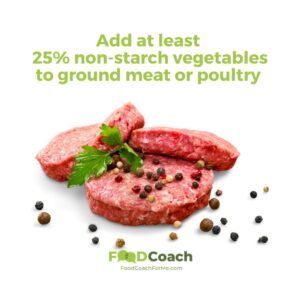
Here’s an idea that will make your grocery dollars go further and will also help you eat healthier: Whenever you’re using ground meat or ground poultry add at least 25% non-starch vegetables to your mix.
This results in juicier, more flavorful burgers, meatloaf, meatballs, chili, and spaghetti sauce.
Getting extra servings of vegetables onto your plate can also help you boost your health and your gut health by increasing the vitamins, minerals, and fiber as well as reducing saturated fat. It’s also a great way to reduce the calories in the dish without making your portion look significantly smaller.
What non-starch vegetables do I recommend?
Ground or shredded carrots work well. So do onions. Frozen spinach that’s been defrosted before adding to the meat works well. Finely chopped cabbage also works.
Tip 5: Replace part of your protein with a less expensive protein
One of the most expensive parts of your meal is your protein source. One easy and healthy way is to think about modifying this area of your plate. Does this mean you need to give up meat, poultry or seafood entirely? Not unless you want to.
Instead, think about swapping out part of the protein on your plate for an option that is less expensive and healthier. One easy way to do this is to make beans part of the protein at a meal. Even slightly reducing the amount of meat or poultry in a dish and adding in beans will reduce your grocery bill and be a healthier choice for your heart, your gut health, and our planet.
Looking for other ways to eat healthier, lose weight or have a healthier gut?
The key to success is understanding how to work with your body and brain. Changing how we eat is about far more than food choices, calories, and how much or how often we eat something. Get your free copy of “5 Secrets to Successfully Changing How You Eat” by clicking here.
If you want personalized help with eating better while saving money on groceries or how to eat to get healthier or stay healthy, start by booking a free discovery call with me. We can discuss what you want to accomplish and see if working with me would be helpful.
Having personally struggled with weight and gut health issues, I understand how easy it is to think that food is the enemy especially with the changes our bodies undergo as we age. It doesn’t have to be that way!
I love using my extensive education and coach approach to help people realize it is possible to feel better and be healthier while still enjoying their life and food.




 Looking for other ways to eat healthier, lose weight or have a healthier gut?


